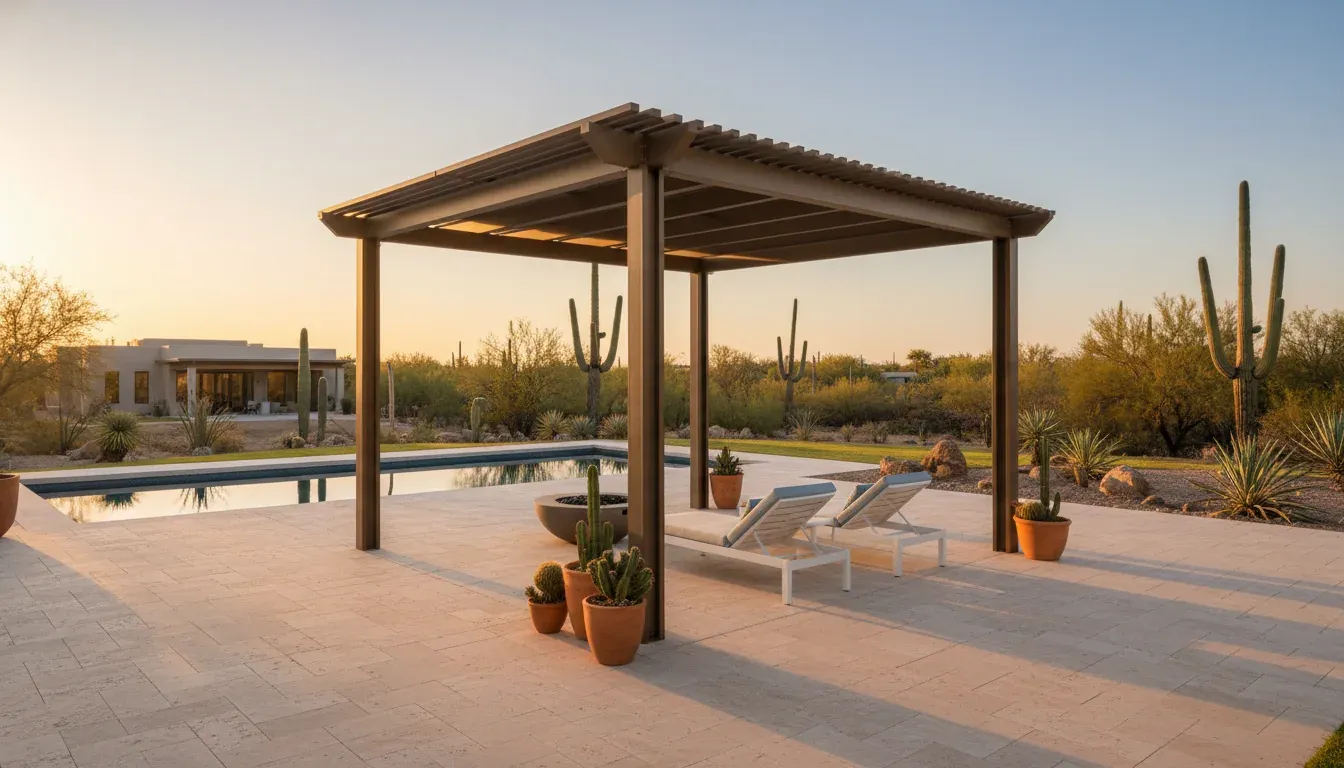
Pergola types · 04 of 06
Steel Pergolas
in Tucson.
Welded steel. Slim profiles. And a 10 to 15 year horizon in Sonoran sun.
Steel is the pergola people ask for by name for a modern desert home, and the profile really is unmatched. It is also the material most likely to disappoint you in Tucson, because here steel rusts. This page is the honest version: what steel does well, what the climate does to it, and why nearly every project we build ends up in aluminum instead.
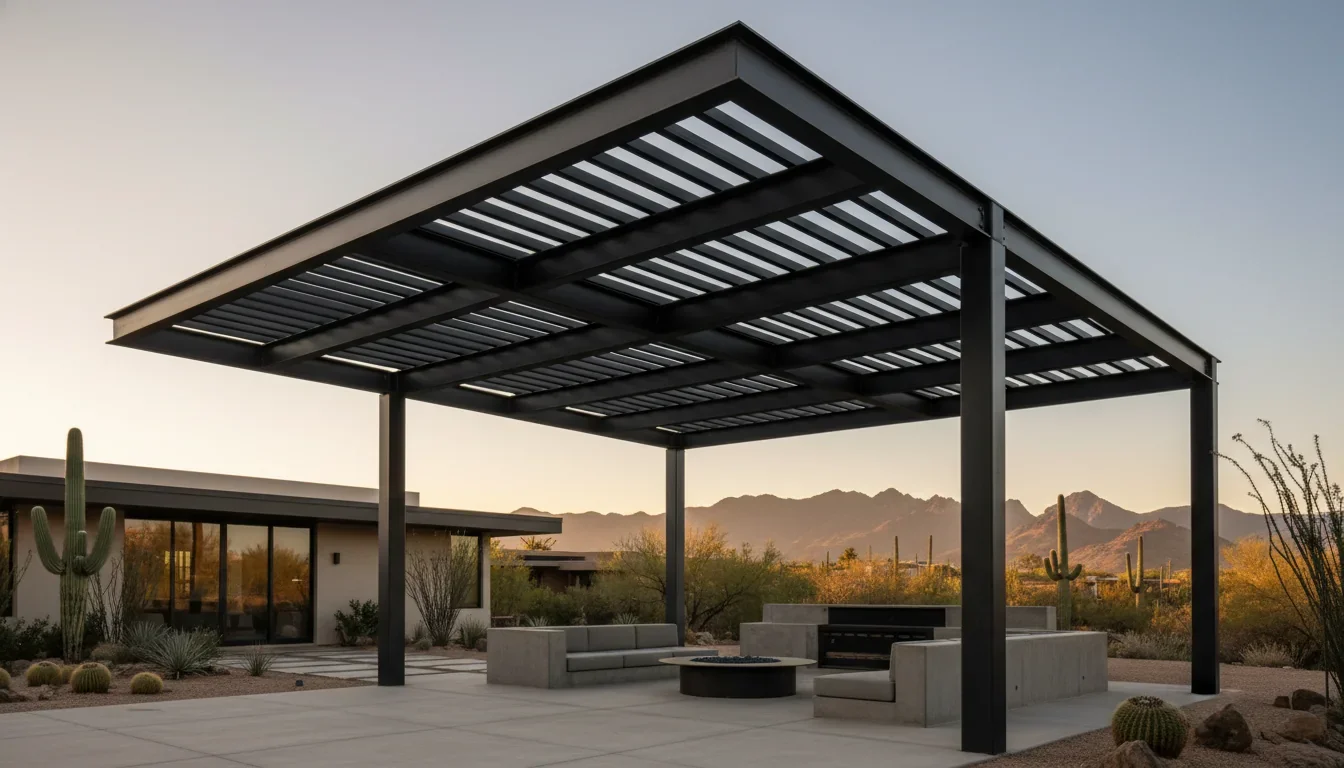
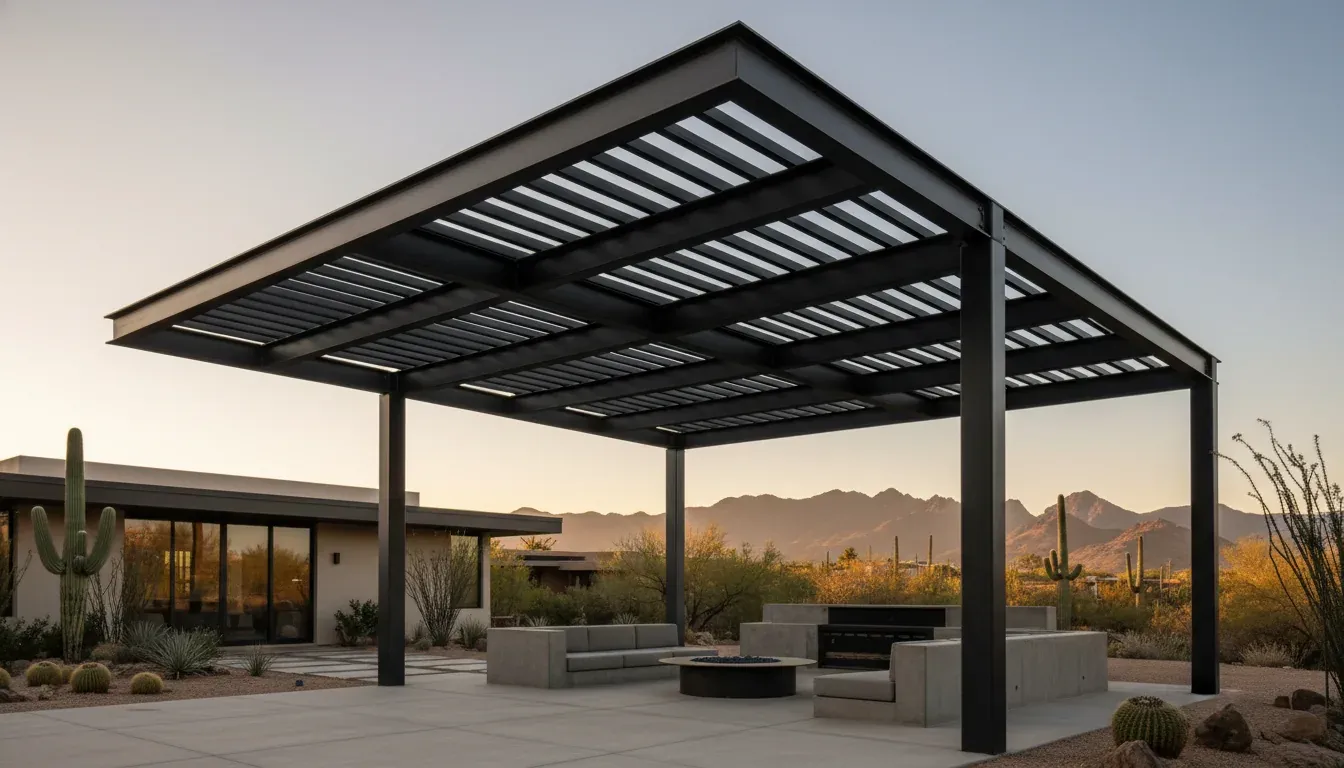
The pergola for architecture
Profile dimensions
wood and aluminum cannot achieve.
A 4"×4" steel post will carry loads that require an 8"×8" cedar post or a 6"×6" aluminum column. That difference is the difference between a pergola that decorates the patio and a pergola that becomes part of the architecture of the house.
In Tucson, where modern desert architecture has been on a 15-year ascent, Rick Joy, Dust, Ibarra Rosano, and the schools they've trained, steel became the default ask for any project where the home itself is contemporary. Slim. Black. Cantilevered. Glass-roofed in some cases.
Two things have changed since that reputation formed. Aluminum profiles got slimmer and aluminum spans got longer, so the look and the post-free span are no longer steel's alone. And fifteen more years of monsoons have made the maintenance picture on desert steel a lot clearer than it was.
A bad steel pergola is harder to fix than a bad anything-else pergola.
What you're actually getting
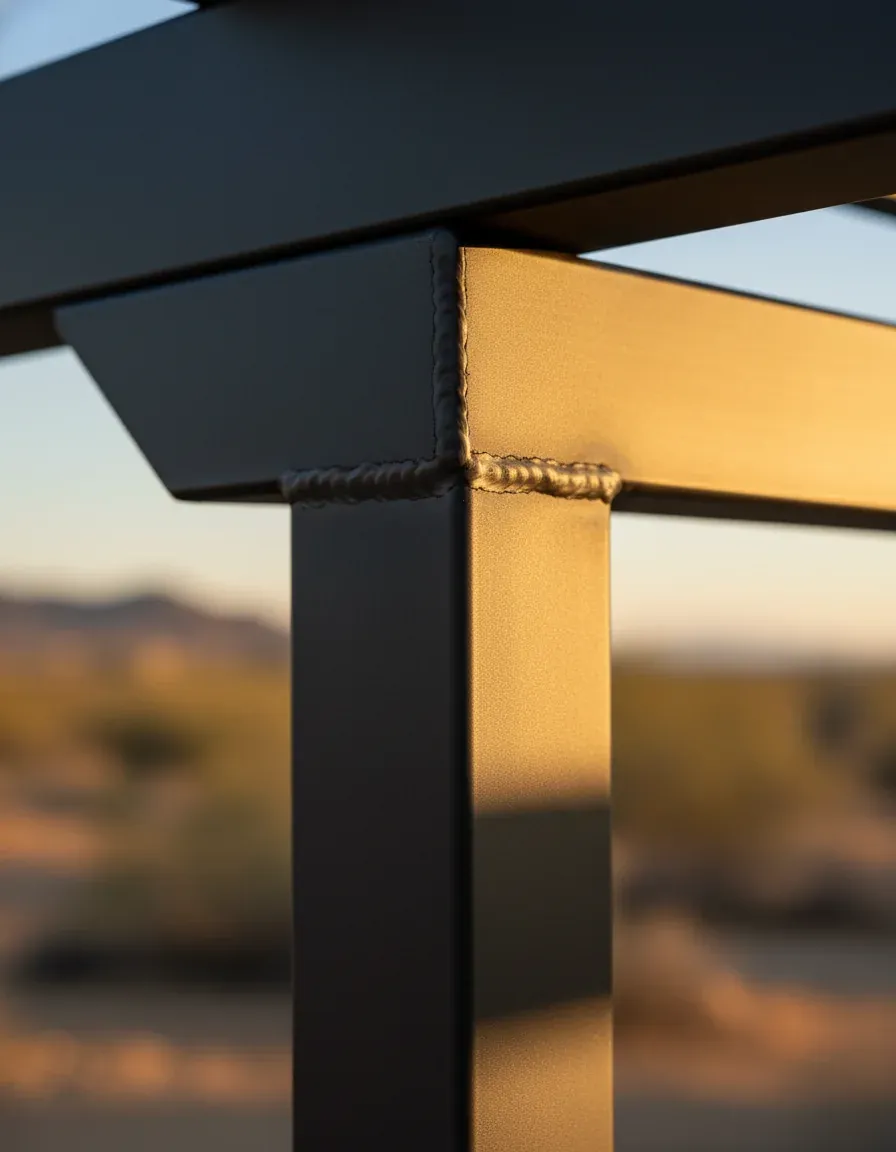
Welded, not bolted.
Continuous, ground flush.
The joints are continuous welds, typically TIG or MIG, ground flush so the structure reads as a single piece of material rather than an assembly of parts. The steel itself is typically A500 or A36 structural tubing, with wall thicknesses between 3/16" and 1/4" depending on span and load.
The critical decision in steel pergola construction in Tucson is the finish, because in this climate the finish is the entire lifespan. Bare steel will rust. Anything less than a properly prepared and applied finish will fail in 5 to 8 years. The standard on every steel pergola here is a shop-applied multi-coat finish, and even that is a delaying action rather than a solution.
Field-painted steel is what gives steel a bad name. We won't install field-painted. If a bid comes in noticeably cheaper than the rest, the finish system is almost always where the money came out.
The four-stage finish
What separates a 15-year steel pergola
from a 5-year one.
-
Sandblast to white metal
Stage oneEvery surface stripped to bare steel. No exceptions, no shortcuts at the welds, no mill scale left behind. This is the foundation the rest of the finish system bonds to. Field-painted steel skips this step entirely, which is why field-painted steel fails at the welds in five to eight years.
-
Zinc-rich primer
Stage twoGalvanic corrosion protection applied directly to bare steel. The zinc sacrifices itself electrochemically before the steel can rust, so even if the topcoats are eventually compromised by impact or wear, the underlying steel remains protected.
-
Epoxy intermediate coat
Stage threeMoisture barrier between the zinc primer and the UV topcoat. The intermediate coat is the layer that separates steel that reaches year fifteen from steel that is bubbling at year six. Cheap pergolas skip this. Shop-finished steel that lasts skips no step.
-
Topcoat: AAMA 2604 or two-part polyurethane
Stage fourPolyester powder-coat (AAMA 2604) for matte and satin finishes, or two-part polyurethane for high-gloss or specialty finishes. Either way, the topcoat is what you see, and it is the layer taking the full force of Sonoran UV. It is also the first line to go, which is why the recoat cycle exists.
This four-stage system, applied in a controlled shop before the pergola reaches the site, is the difference between steel that lasts 10 to 15 years here and steel that is rusting at the welds by year six. It is the only way we would build one. Note what it is not: a permanent fix. Every stage above is a delaying action against a climate that wins eventually.
Standard inclusions
What ships on a licensed
Tucson steel build.
-
Welded A500 or A36 structural steel
Continuous, ground-flush welds. The structure reads as one piece
-
Project-specific engineering
Wind and soil calculations run per lot, stamped by a licensed AZ engineer
-
Four-stage shop-applied finish
Sandblast, zinc primer, epoxy, polyester or polyurethane topcoat
-
Concealed connections
Anchor bolts hidden inside posts. No exposed brackets
-
Engineered footings
Sized for soil conditions, with embedded steel plates
-
Custom profile fabrication
Round, square, rectangular, or fully custom milled
-
Optional roof infill
Steel slats, cable mesh, glass panels, or metal panel
-
A written recoat schedule
Steel is the one material here with upkeep built into its service life
Steel infill, glass panels, cable mesh, integrated lighting, and custom profiles are coordinated during design. The engineering and finish standards do not flex, and neither does the recoat schedule you will be handed at walkthrough.
What it costs in Tucson
What actually drives
a steel quote.
-
Fabrication
Steel is cut, welded, and finished to the specific opening before it ever reaches the site, so the shop time is a real part of the number.
-
Span and post count
Clearing a wide span without a center post is where steel gets specified, and it is the biggest lever on the price.
-
The finish system
In full Sonoran sun the coating is the whole ballgame. A shop-applied multi-stage system costs more up front and is the only thing holding back corrosion.
-
Ongoing upkeep
Steel is the one material here with a recoating cycle built into its life. Budget for the refinish, not just the install.
Steel projects are quoted after a site visit. Read the maintenance section above before you weigh the number, because with steel in this climate the install cost is only part of what you are signing up for.
Why it works in Tucson
Steel is the right answer
to a specific set of conditions.
Steel isn't the right material for every Tucson pergola. It's the right material for five specific scenarios, and the wrong premium to pay for everything else.
-
Where steel still gets asked for
Rick Joy, Dust, Ibarra Rosano
Contemporary Tucson architecture, flat roofs, rammed earth walls, steel-frame windows, board-formed concrete, calls for materials with industrial precision. Steel matches that language, and it is usually the architect or the homeowner who names it first. The look is not the problem. What happens to it here is.
-
The corrosion clock starts on day one
Monsoon humidity, 60 to 70%
Steel does not fail structurally in this climate, it fails at the finish, and once the finish is compromised the corrosion runs underneath it. Late-summer monsoon humidity, dust that holds moisture against the surface, and 60 degree daily temperature swings that work every coating seam all shorten that clock. Realistically you are looking at 10 to 15 years before it needs serious attention, not 30.
-
The welds go first
Where you will see it start
Corrosion shows up at the welds and the fasteners before anywhere else, because that is where surface prep is hardest to get perfect and where the coating is thinnest. Field-painted steel shows rust at the welds within 5 to 8 years. Even shop-finished steel with one shortcut taken on prep will do the same, and you will not know which you bought until it happens.
-
Wide spans without a center post
Catalinas, Rincons, Santa Ritas
Tucson's residential architecture often centers on mountain views, and a center post in the middle of the patio interrupts that view. Steel used to be the only way to clear a wide span. That is no longer true. The engineered aluminum systems we install now clear up to 24 feet on a single beam with no center post, which covers nearly every patio in this metro without putting corrosion on the schedule.
-
Cantilevered overhangs
Asymmetric structural loads
Asymmetric cantilevers, overhang on one side and posts on the other, are the one case where steel still has a genuine structural argument. If your design truly requires that geometry, say so on the first call and it gets engineered honestly, with the maintenance reality written into the proposal rather than left out of it.
The premium is justified for the right project. It isn't justified for every project.
HOA, permits, Pima County
Where finish color
becomes the submission.
Steel pergolas in Pima County require a residential building permit and a stamped structural engineering set. The engineering stamp matters more for steel than for any other material. Wide spans, cantilevers, and high wind ratings all require detailed structural calculations that less specialized installers can't produce in-house. Every installer in our steel-capable network works with a licensed structural engineer on every project.
HOA review varies more for steel than any other material
Modern-architecture-friendly neighborhoods (parts of Sabino Canyon, Dove Mountain, newer Marana developments): Steel pergolas in matte black or dark bronze finishes typically approve in 2 to 3 weeks with minimal friction.
Traditional desert-architecture neighborhoods (much of Catalina Foothills and surrounding established Foothills communities): Steel can face additional ARC scrutiny if it reads as too industrial. We typically guide these submissions toward warmer powder-coat colors, bronze, dark sand, weathered copper, and ramada-influenced profiles rather than pure modern minimalism.
HOAs with strict material palettes: A small number of Foothills sub-associations limit pergolas to wood or aluminum only. We'll tell you up front during the site walk if your specific HOA falls into this category, before any quote is built.
How the project moves
From engineering set
to first weld bead.
-
Reach out
Day oneA quick call with a licensed Tucson steel fabricator covers your span, your home's architecture, the look you have in mind, and a rough budget. You get straight answers to your first questions before anyone visits.
-
Schedule a consultation
Week 1The on-site visit for steel takes longer than for other materials. A licensed installer measures spans, looks at view corridors, checks soil conditions for footing requirements, and talks through whether your home is best served by a clean modern profile or a warmer, more traditional steel ramada.
-
Review design options
Weeks 2–4Two design directions come back, with a structural engineer engaged for preliminary calculations and a line-itemed quote. Steel design takes about a week longer than aluminum because the engineering is more involved and the fabrication options are more variable.
-
Proceed with installation
Weeks 4–10Pima County permits and any HOA submission are handled first. Shop fabrication of the steel components and the four-stage finish system runs in parallel, typically 3 to 4 weeks. Footing excavation and pour follow, 2 to 3 days plus a 7-day cure, then steel delivery and erection, 1 to 2 days for an attached pergola and 2 to 4 days for a freestanding cantilevered design. Final connections, infill, and lighting take another 1 to 2 days.
-
Final walkthrough & inspection
Final dayYour installer hands off the engineering set, warranty package, and a finish-system care binder. A check-in follows at 30 days and 6 months, and the first finish inspection is at 5 years.
Every step has a name and a date. You'll never have to ask where we are.
Steel reviews
Tucson homeowners on their
steel pergolas.
I came in set on steel for the pool span. They walked me through what the sun does to it here and showed me an aluminum system that held the same 24-foot span with no center post. Same look, none of the rust talk. Glad I got the honest version first.
Metal pergola, welded steel, powder-coated, and I knew going in it would need recoating down the road. They put the schedule in writing instead of pretending it was maintenance-free. Three monsoon seasons and it hasn't moved a millimeter.
Desert-modern house, and I assumed steel was the only thing slim enough. Turned out it wasn't. What sold me was being told plainly what steel does in this climate before I had signed anything. One point of contact, line-item quote, flawless install.
Steel & metal pergola installation across greater Tucson
Steel & metal pergolas across Southern Arizona.
Licensed steel and metal pergola fabrication, for welded, powder-coated, wide-span and cantilever builds, throughout the greater Tucson metro and Pima County.
- Tucson
- Catalina Foothills
- Oro Valley
- Marana
- Vail
- Sahuarita
- Green Valley
- Sabino Vista
- Saguaro Ridge
- Dove Mountain
- Pima County
- And nearby areas
Steel pergola questions
What every Tucson homeowner
asks about steel.
-
01. How long does a steel pergola last in Tucson?
Realistically 10 to 15 years in Sonoran conditions before it needs serious attention. You will see longer numbers quoted elsewhere, and they come from climates that are not this one. The steel itself does not fatigue. The finish degrades, and once it does, corrosion runs underneath it. A steel pergola here is not a permanent structure, and anyone telling you it is a 30-year build has not maintained one through fifteen Tucson monsoons. -
02. Will my steel pergola rust?
Eventually, yes. The four-stage system, sandblast, zinc primer, epoxy intermediate, polyester or polyurethane topcoat, buys you real time, and it is the only way we would ever build one. But it slows corrosion, it does not stop it. Rust shows at the welds and fasteners first, because that is where surface prep is hardest and the coating is thinnest. Field-painted steel shows it within 5 to 8 years. If rust-free at year 20 is the requirement, the honest answer is aluminum. -
03. How hot does a steel pergola get?
The surface of a black steel beam in direct Tucson July sun can reach 160 to 180°F, hotter than aluminum or wood by 10 to 20°F. The shade temperature below the pergola is the same as under any material. Surface heat is only a factor if you touch the structure directly, which is rare except at posts you might lean against. Lighter powder-coat colors run 15 to 25°F cooler. -
04. Steel vs aluminum, which should I choose?
In this climate, aluminum, and it is not close. Aluminum does not rust, carries a 50-year structural warranty, is rated from 170 mph, and the systems we install clear up to 24 feet on a single beam with no center post. Steel used to win on span and on profile. It no longer wins on span, and modern aluminum profiles have closed most of the gap on looks. What steel still has is the true asymmetric cantilever. Everything else it used to be chosen for, aluminum now does without a corrosion clock. See aluminum pergolas. -
05. Can I get a steel pergola past the Foothills HOA?
Yes, in most sub-associations, with appropriate finish selection and profile design. Matte black contemporary profiles approve readily in modern-friendly Foothills neighborhoods. Warmer earth-tone finishes and ramada-influenced profiles approve readily in traditional desert-architecture neighborhoods. A small number of sub-associations restrict steel. We'll know during the site walk. -
06. What about lightning?
Properly grounded steel pergolas with structural connection to a grounding rod or to the home's existing grounding system handle direct lightning strikes without structural damage and without conducting damaging current into the house. A licensed installer grounds every steel pergola as standard. The grounding inspection is part of the final commissioning.
Have a question we didn't cover? Ask it in the form below. We answer most within the hour.
Local steel pergola fabrication you can count on
Want the steel look without the steel maintenance?
Slim profiles and post-free spans, engineered for this climate rather than against it. Your project starts with a licensed Tucson pro who will tell you plainly whether steel or aluminum is the right call for your lot, your span, and how long you plan to be in the house.
Or call (520) 639-9422 · Mon–Fri 8a–5p
Tell us about your lot, get a quote from a licensed Tucson steel fabricator.
Service area
- Tucson
- Catalina Foothills
- Oro Valley
- Marana
- Vail
- Sahuarita
- Green Valley