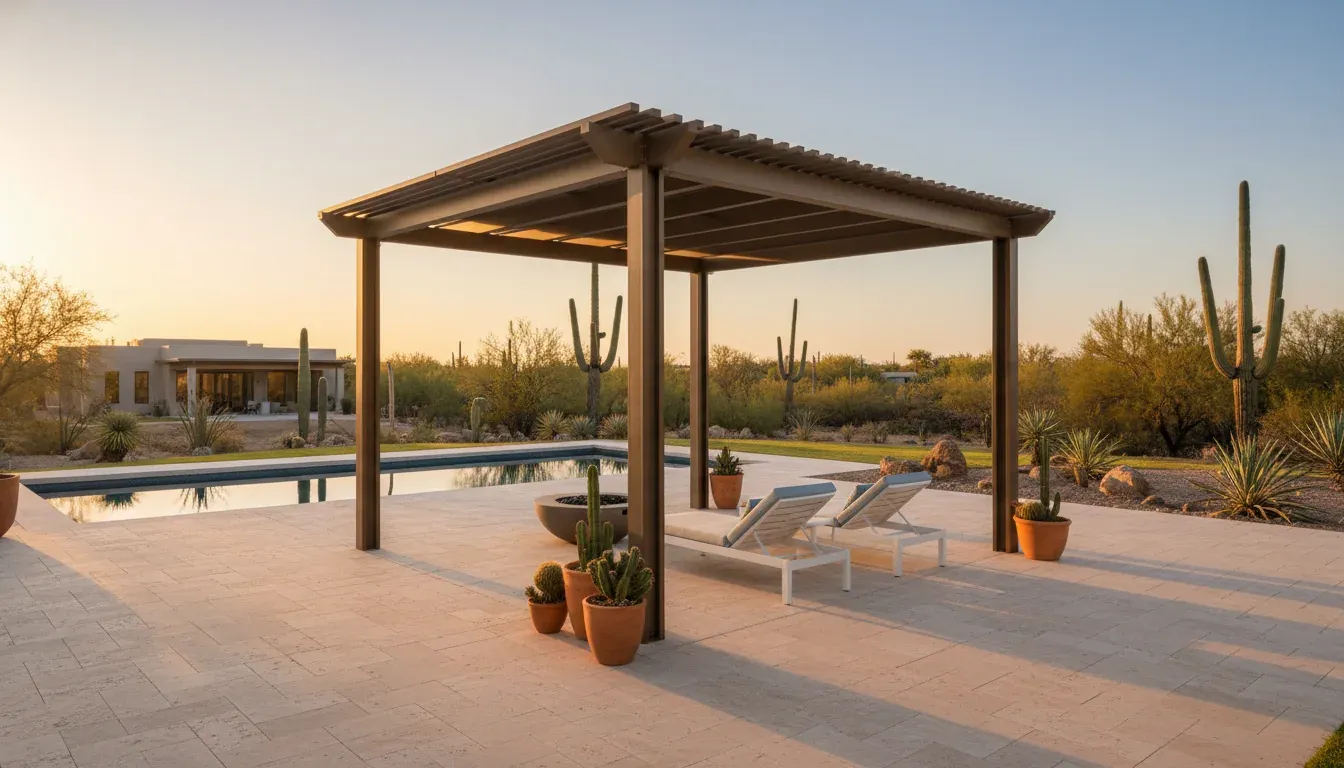
Pergola types · 06 of 06
Freestanding Pergolas
in Tucson.
Engineered footings. No roof tie-in required. The most flexible footprint on the lot.
A freestanding pergola is what you build when the best spot in the yard isn't against the house. The pergola that goes where the lot tells it to go, rather than where the house allows. For roughly a third of the Tucson homeowners we work with, freestanding is the right answer the moment we walk the property.
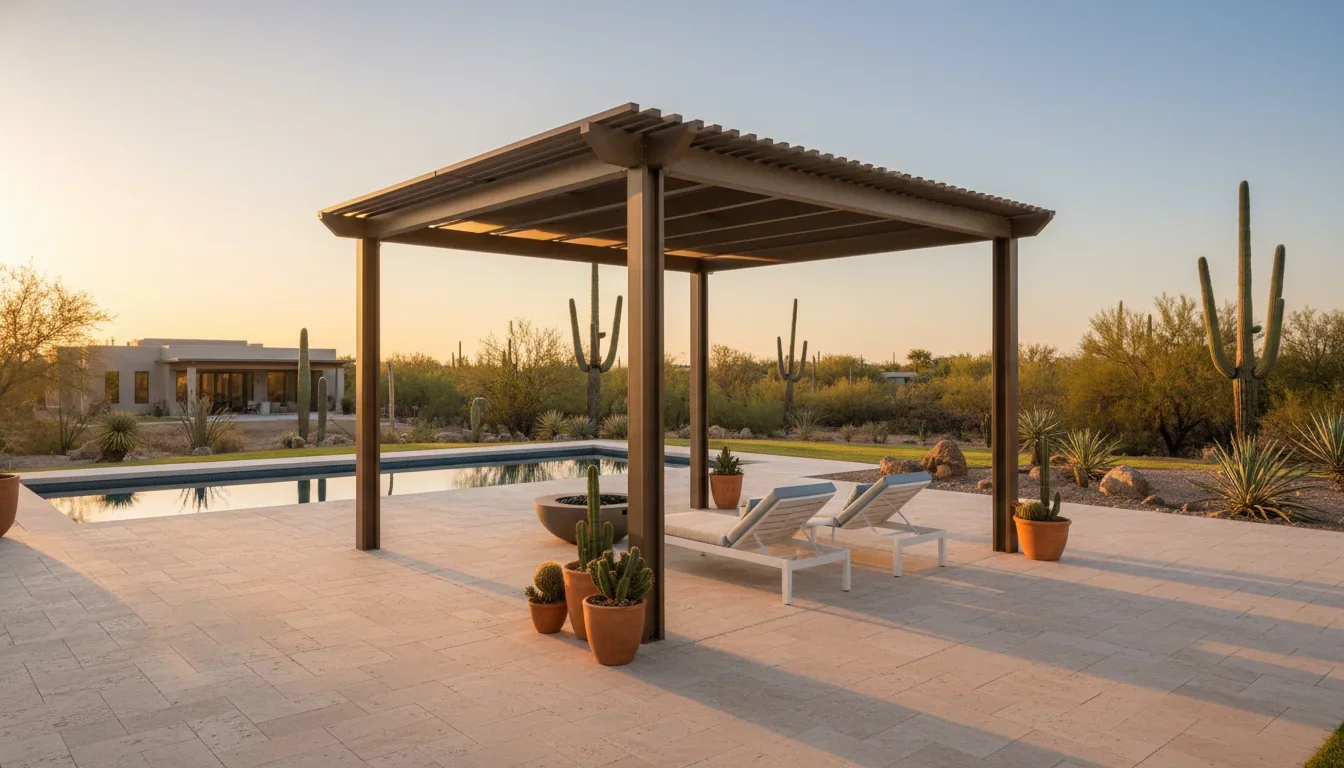
The pergola that goes where the yard wants it
A destination,
not an extension.
A freestanding pergola is the pergola that anchors a poolside seating area 40 feet from the back wall. The one that defines a garden corner under an existing mesquite. The one that creates an outdoor dining room in the middle of a new patio that didn't exist yet.
For roughly a third of the Tucson homeowners we work with, the house has the wrong wall facing the wrong direction. The patio is detached. The pool is the center of gravity, not the back door. Or the homeowner wants the pergola to feel like a destination, a place you walk to, not a place you walk under on your way to the lawn.
A freestanding pergola in the right location is the most-used room in the house.
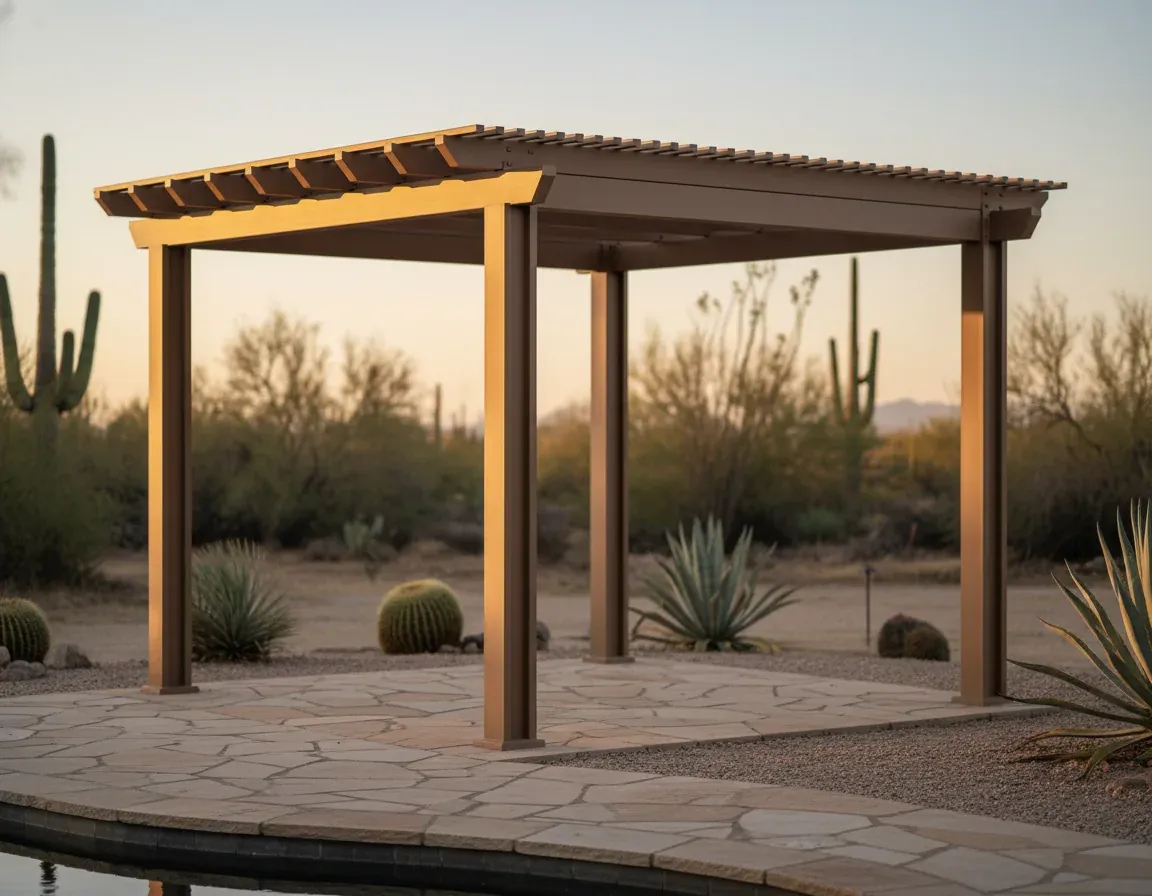
What you're actually getting
Structure underneath,
lightness on top.
Without a connection to the home, the pergola carries all of its own wind, dead, and live loads through the posts and footings. That means more posts (typically 4 for builds up to 12'×14', 6 for larger), deeper footings (36 to 48 inches below grade in Tucson soil), and more substantial post profiles.
A freestanding 6"×6" post often handles loads that a 4"×4" attached post could carry with bracing from the house. Cross-bracing or moment connections resist lateral wind loads without a wall to brace against.
None of this should be visible in the finished pergola. The visual result of good freestanding engineering is a pergola that looks light, even though the structure underneath it isn't.
Where freestanding makes sense
Five patterns
that come up most often.
A specific set of Tucson scenarios where freestanding isn't just an option but the right answer.
-
Poolside anchor
Define the seating, get the afternoon shade
A freestanding pergola at the long side or corner of a pool defines the seating area, provides essential afternoon shade, and creates a visual focal point that most Tucson pools don't have. Footing depths can be engineered to coexist with existing pool plumbing and decking.
-
Garden destination
Under the mesquite or palo verde
A pergola placed under an existing mesquite, palo verde, or ironwood, with the canopy threaded through the branches, creates a destination spot in the yard that feels older than it is. Mature Tucson landscapes often suggest these placements before the homeowner does.
-
Detached patio creation
A flat area becomes an outdoor room
A currently unused flat area of the yard becomes a usable outdoor room with a freestanding pergola plus a poured concrete or paver pad beneath. Common in Marana, Vail, and outer Oro Valley, where homes often sit on larger lots with substantial unused yard area.
-
Architectural buffer
Privacy, screen, microclimate
A freestanding pergola placed between the house and an adjacent property creates privacy, defines a side yard, or buffers wind from a prevailing direction. Freestanding pergolas can serve as visual screens, sound buffers, and microclimate moderators on tight Foothills lots.
-
When attaching isn't an option
Wrong wall, wrong roof, wrong rules
Some homes simply can't accept an attached pergola: wrong roof angle, structural framing not amenable to the connection, HOA prohibitions on attached additions, or a wall surface (rammed earth, stone) that can't be penetrated. Freestanding is the answer when attaching isn't.
A freestanding pergola in the wrong location is a structure looking for a purpose. In the right location, it's the most-used room in the house.
Standard inclusions
What ships on a licensed
Tucson freestanding build.
-
Stamped structural engineering
Site-specific wind and soil calculations, licensed AZ engineer
-
Concrete footings
36–48" deep in Tucson caliche, sized per soil and load
-
Engineered post connections
Designed to resist both gravity and lateral wind loads
-
Material flexibility
Aluminum, wood, steel, or motorized louvered. Your call
-
Optional buried electrical
Conduit run from the home for lighting, fans, motors, sound
-
Optional patio surface
Concrete or paver pad designed in coordination with footings
-
Drainage planning
Grading so monsoon runoff doesn't undermine footings
-
Footing warranty
10+ years on settlement and concrete integrity
Material selection (aluminum, wood, steel, or motorized louvered) is a separate decision. The footing, engineering, and electrical standards apply to all of them.
What it costs in Tucson
What actually drives
a freestanding quote.
-
Footings and concrete
A freestanding structure carries its whole load on its own footings, so the concrete work runs deeper and the post profiles run heavier.
-
Span and post count
Clearing a wide span without a center post is an engineering problem before it is a materials problem, and it is the biggest single lever on the number.
-
Site conditions and access
Caliche depth, grading, and whether equipment can physically reach the spot decide how much groundwork happens before anything goes vertical.
-
The surface underneath
Pouring new concrete or laying pavers beneath the pergola is its own scope, priced separately from the structure.
Freestanding builds are quoted after a site visit. Two yards with the same footprint can need very different foundations, and that difference is decided in the dirt, not on a spec sheet.
Why freestanding works in Tucson
Sonoran landscapes
invite anchoring.
Lot sizes support it
The median Tucson residential lot is roughly 8,500 sq ft, with most Foothills, Oro Valley, and Marana lots ranging from 10,000 to 25,000 sq ft. Compared to dense urban markets, Tucson homeowners have room to place a pergola at a distance from the house, and the distance often produces a more compelling result.
Mature desert landscapes invite anchoring
Tucson's mature landscape vocabulary, mesquite groves, ocotillo, prickly pear, palo verde, saguaro, creates natural focal points around the yard. A freestanding pergola positioned within or adjacent to existing mature plants integrates into the landscape in a way that a freestanding pergola on a manicured lawn never quite does. The pergola becomes part of the desert garden.
Pool culture
A significant share of Tucson homes have pools, and most of them were built before outdoor living trends made integrated shade standard. A freestanding pergola placed at the pool deck is one of the most common pergola applications in the region, the pool is already there, the surrounding deck is already there, and a pergola is what turns a hot, sun-exposed pool into a usable summer space.
Soil and footings are predictable
Tucson's caliche soils, challenging for some construction tasks, are actually advantageous for freestanding pergola footings. Caliche is structurally stable, drains well, and holds concrete footings extremely well once excavated. We rarely encounter the soil-related footing issues that complicate freestanding pergola installations in clay-heavy or sandy climates.
Wind exposure can be managed
Freestanding pergolas have higher lateral wind loads than attached pergolas because there's no wall to brace against. In Tucson, where prevailing wind direction during monsoon season is well-documented and consistent (typically south-southeast), engineers can orient and brace freestanding pergolas to resist the dominant load direction efficiently. Properly engineered freestanding pergolas hold up reliably through monsoon events.
HOA, permits, Pima County
Where setbacks
enter the conversation.
Freestanding pergolas in Pima County require a residential building permit and a stamped structural engineering set, with site-specific footing and wind-load calculations. Setback requirements vary by zoning district. Most residential zoning requires freestanding accessory structures to sit at least 5 to 10 feet from property lines, with specific exceptions for height and footprint.
A licensed installer handles permitting, including setback verification and any required survey work to confirm property line locations before footings are poured.
HOA submissions add two considerations
HOA submissions for freestanding pergolas in Foothills and Oro Valley sub-associations are similar to attached pergolas, with two additional considerations: placement on the lot (most ARCs want to see exactly where the pergola will sit relative to the home, neighboring properties, and existing landscape), and color and material consistency with the home (even though the pergola isn't attached, ARCs typically require the finish to complement the home's exterior palette).
Submissions typically clear within the standard ARC review window when placement, finish, and the surrounding landscape context are addressed in the submission package.
How the project moves
From location decision
to first footing pour.
-
Reach out
Day oneA quick call with a licensed Tucson pergola pro covers your lot, how you want to use the space, the look you have in mind, and a rough budget. You get straight answers to your first questions before anyone visits.
-
Schedule a consultation
Week 1The on-site visit for freestanding takes longer than for attached, because location selection is half the design conversation. A licensed installer walks the lot, looks at sun angles through the day, checks view corridors and drainage patterns, and talks through how you actually want to use the space.
-
Review design options
Weeks 2–4Two design directions come back in two possible locations (when more than one is viable), with a structural engineer engaged for footing and wind calculations and a line-itemed quote. If the project includes a new patio surface, the patio design is coordinated in parallel.
-
Proceed with installation
Weeks 4–9Pima County permits and any HOA submission are handled first. Footing excavation then takes 2 to 3 days, with concrete pour and a 7-day cure. A new patio surface, if part of the project, is poured during the cure period. Pergola assembly and finishing typically run 4 to 8 days on site depending on material.
-
Final walkthrough & inspection
Final dayYour installer demonstrates any integrated features, walks you through the structure, and hands you the engineering set, warranty package, and care binder. A check-in follows at 30 days and 6 months, and footings are inspected at the 6-month and 24-month visits to confirm no settlement.
Every step has a name and a date. You'll never have to ask where we are.
Freestanding reviews
Tucson homeowners on their
freestanding pergolas.
Poolside, no tie-in to the house. The installer on our project engineered the footings for our caliche soil and monsoon wind. It anchors the whole backyard now, exactly where we wanted shade.
Garden corner, four-post freestanding cedar. They talked us out of attaching it (drainage made freestanding smarter) and the pro was honest about it from the first call.
Brand-new patio with nothing to attach to. Six-post freestanding steel, full footprint flexibility, one point of contact who pulled the permit and engineered the footings. Flawless.
Freestanding pergola installation across greater Tucson
Freestanding pergolas across Southern Arizona.
Licensed installation for freestanding pergolas, four-post and six-post, on engineered footings sized for caliche soil and monsoon wind, throughout the greater Tucson metro and Pima County.
- Tucson
- Catalina Foothills
- Oro Valley
- Marana
- Vail
- Sahuarita
- Green Valley
- Sabino Vista
- Saguaro Ridge
- Dove Mountain
- Pima County
- And nearby areas
Freestanding pergola questions
What every Tucson homeowner
asks about freestanding.
-
01. Where can I put a freestanding pergola on my lot?
Anywhere that meets your zoning setback requirements (typically 5 to 10 feet from property lines in Tucson residential zones) and your HOA's siting guidelines, if applicable. There are no structural restrictions. Freestanding pergolas can be built on virtually any reasonably flat surface, including over existing concrete or paver patios. We'll verify your specific setback requirements during the site walk before any design work begins. -
02. Do I need a patio under the pergola, or can it sit on grass or gravel?
You can install a freestanding pergola over grass, gravel, decomposed granite, or any other yard surface. The pergola's footings extend through whatever surface is there into engineered concrete piers below grade. Many Tucson freestanding pergolas sit over decomposed granite or gravel patios rather than over poured concrete. The choice is aesthetic and budgetary, not structural. -
03. Freestanding vs attached, how do I decide?
Freestanding if the best location for the pergola is away from the house, if you want a destination space rather than an extension of the house, if your home's architecture or HOA doesn't accommodate attachment, or if the pergola is anchoring a pool or garden. Attached if the patio is directly against the house and continuous shade from the wall outward matters. The site walk usually makes the answer obvious within 20 minutes. -
04. How deep are the footings?
Typically 36 to 48 inches below grade for freestanding pergolas in Tucson, depending on post size, pergola height, expected wind loads, and soil conditions. Footings are sized by the structural engineer for your specific project. Tucson's caliche subsoil is excellent for footing performance. Once a footing is set in compacted caliche, settlement and lateral movement are minimal. -
05. Can I move a freestanding pergola later if I change my mind?
In theory, yes. In practice, almost never. The footings are poured concrete, and relocating the pergola requires either demolishing and replacing the footings, which is a substantial job on its own, or accepting visible patches in the original location. The right approach is to make the location decision deliberately at the site-walk stage. We'll spend extra time on this if you're uncertain. -
06. What about running electrical to a freestanding pergola?
Standard practice. We trench a buried electrical conduit from the home to the pergola during construction, sized for the planned loads (lighting, fans, motorized louvers, sound, heaters, outlets). The conduit is buried 18 to 24 inches below grade, sealed at both ends, and inspected by Pima County before being backfilled. Electrical permit and inspection are separate from the building permit and are handled by your installer.
Have a question we didn't cover? Ask it in the form below. We answer most within the hour.
Local freestanding pergola installation you can count on
Want shade anywhere on your lot?
Poolside, garden corner, or the anchor of a brand-new patio, on engineered footings with no roof tie-in. Your project starts with a licensed Tucson installer who fits the build to your site, your soil, and your timeline.
Or call (520) 639-9422 · Mon–Fri 8a–5p
Tell us about your lot, get a quote from a licensed Tucson freestanding pro.
Service area
- Tucson
- Catalina Foothills
- Oro Valley
- Marana
- Vail
- Sahuarita
- Green Valley